What Size Dumpster for Concrete, Dirt, or Brick? (Bigger Is Not Safer)
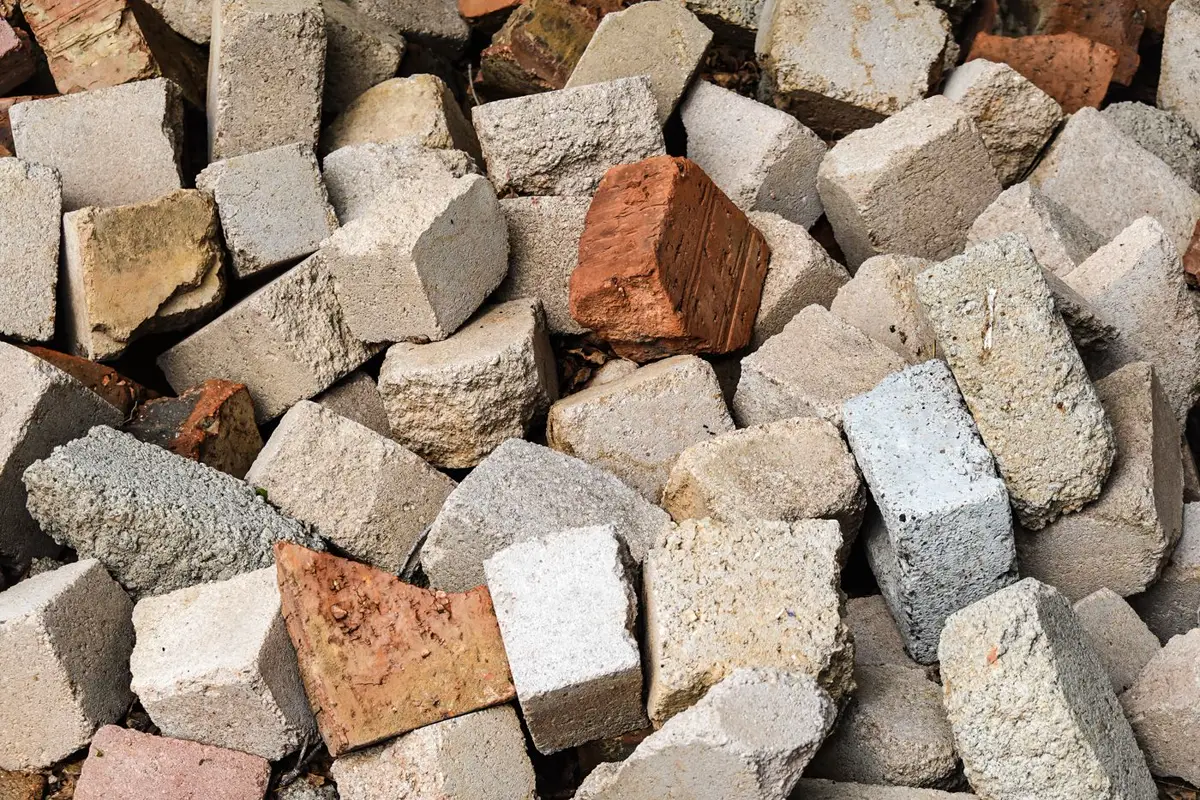
The stencil on the steel is cubic yards. Concrete is tons. Those are different problems.
A patio demo looks small. A leftover dirt pile looks smaller. A 20-yard dumpster with a 2-ton cap is how either of those becomes the expensive half-empty box. You can still see daylight. The landfill scale cannot.
You do not need a zip code to size a heavy-debris dumpster. You need to know what you are throwing, whether the load is clean, and which product the hauler is quoting: a mixed-waste 10-yard with 1–2 or 2–3 tons included, or a heavy-debris 10-yard they say can carry up to 10 tons. Same stencil. Different SKU.
This page is the dedicated concrete / dirt / brick / asphalt URL. It is not a quote form. It is not a reprint of kitchen guts, roof squares × layers, a house-cleanout furniture table, or the 14-foot vs 22-foot driveway fight. Live charts disagree on fill-partway vs “size up slightly,” on whether a 15- or 20-yard may haul heavy debris, and on how many tons a 10×15 patio weighs. Every number below is that publisher’s, dated to the fetch. Do not average them. Do not mash the mixed-waste 10-yard into the 10-ton heavy-debris 10-yard.
If you need the household map (yard vs ton, all five sizes), that is What size dumpster do I need?. If two quotes landed on a 10 and a 20 because of driveway length, that is 10-yard vs 20-yard.
What counts as heavy
Dumpsters.com’s size FAQ is blunt: you cannot put heavy materials in every dumpster size. Dense stuff — concrete, brick, dirt, or shingles — should go in a 10-yard, and you fill it only partway. Their “what size” page: a 10-yard is “best for concrete, dirt and other heavy materials.” Their weight-calculator page adds block and asphalt to that heavy-debris list.
Hometown’s estimate-weight guide (updated July 15, 2025) publishes pounds-per-cubic-yard for the same pile, as their averages:
| Material (Hometown, July 15, 2025) | Their lb per cubic yard |
|---|---|
| Concrete | 4,050 |
| Asphalt | 3,960 |
| Standard red clay bricks | 3,400 |
| Earth / dirt, loose and dry | 2,100 |
| Earth / dirt, excavated / wet | 3,000 |
| Gravel or crushed stone | 2,600 (they say 20% more if wet) |
Hometown’s older worksite guide (updated September 1, 2022) is in the same neighborhood and not identical: concrete ~4,000 lb (2 tons) per cubic yard; bricks 2,500–3,500; dry dirt 2,000; wet dirt 3,000. Same company. Two tables. Keep both. Do not blend them into an “industry standard.”
Sometimes, by market: tile, roofing shingles, plaster, stucco, sod, sand, rock. Waste Management’s Bagster specs page: in some zips, tiles, roofing shingles, and drywall are also treated as heavy debris. Angi (updated July 9, 2026): heavy loads like shingles, bricks, stones, or dirt need a smaller dumpster to stay within the weight limit. Their landscaping row is 10 or 15-yard because rocks, stumps, and dirt are heavy.
If the pile is cabinets, sofas, or bags of clothes, you are on the wrong page. That is volume. See kitchen remodel or house cleanout. If it is a roof, size by squares × layers, not by this table — shingles.
Two products that share a 10-yard stencil
A 10-yard dumpster is 10 cubic yards of interior volume — 270 cubic feet of space. Dumpsters.com’s 10-yard page: it is not 10 feet long, and it is not 10 tons. The yard number does not lock the tonnage. The contract does.
Live Dumpsters.com pages, fetched the same day, describe at least two different 10-yards:
| Product (Dumpsters.com) | What they say it is for | Included / typical tons | The 10-ton figure |
|---|---|---|---|
| Mixed-waste 10-yard on the size chart | Heavy debris, light renovation; 3 pickup loads | 1–2 tons | Not the included cap. Chart row only. |
| 10-yard product page | Concrete, a section of driveway, shingles, small cleanouts | Average 2–3 tons (4,000–6,000 lb) | A 10-yard can safely hold up to 10 tons — they treat that as a different, heavier job. |
| Heavy-debris dumpster on the weight-calculator page | Concrete, brick, block, dirt, or asphalt | Up to 10 tons | Extra boxes if you have more than 10 tons: 10–20 tons → 2 dumpsters; over 20 tons → call. |
| Concrete dumpster page | Concrete-only | Typical 10 tons / 20,000 lb | Same 10-ton ceiling. Average cost on that URL is not used here. |
| Dirt dumpster page | Dirt-only loads | Typical 10 tons / 20,000 lb | “To meet road safety guidelines.” Extra boxes or empty-and-return if you need more. |
Hometown’s November 10, 2025 size chart puts a typical mixed 10-yard at 2–3 tons (4,000–6,000 lb). Their dedicated concrete page (January 19, 2023) uses that same 2–3 ton band, then immediately shows why it is often not enough: 1 cubic yard of concrete = 4,000 lb, or 2 tons — their average. One yard of their concrete fills the whole typical mixed-waste allowance.
Do not mash these into one SKU. A mixed-waste 10-yard with a 1–2 or 2–3 ton cap, loaded with a slab, is the half-empty overage. A heavy-debris / concrete / dirt 10-yard with a 10-ton cap is the product Dumpsters.com’s calculator is talking about when it says “less than 10 tons → 1 heavy debris dumpster.” Ask which one is on the quote.
Dumpsters.com’s weight-limits page says the quiet part: most of the time their limits fall between 1 and 5 tons, but the containers can safely hold up to 10 tons — “the maximum limit.” You are not automatically buying the maximum. You are buying the included tons.
Fill-partway vs sizing the tons (the disagreement)
Dumpsters.com’s instinct, on the size FAQ, is: smaller box, do not fill it. Hometown’s instinct, on the how-to-choose page (updated March 2, 2023), is: a small volume of concrete may still need you to “size up slightly” so the weight allowance fits — not so you can chase a 40-yard of air.
Those are not opposite physics. They are opposite slogans for the same scale ticket.
| Source | Size they point at | Fill / sizing rule | Tons they actually publish | The catch |
|---|---|---|---|---|
| Dumpsters.com sizes FAQ | 10-yard | Fill partway. Cannot put heavy materials in every size. | Chart: 10-yard 1–2 tons typical | The small box is the heavy-debris tool because of weight, not because the patio is small. |
| Dumpsters.com 10-yard product page | 10-yard | Outdoor projects listed: “removing heavy debris, like concrete”; “repairing a section of a driveway.” | Average 2–3 tons; safe max 10 tons | Three Dumpsters.com answers for a 10-yard’s tons: 1–2 (chart), 2–3 (product page), 10 (safe / heavy-debris). The contract is the included tons. |
| Dumpsters.com weight calculator | Heavy-debris 10-yard | Extra boxes above 10 tons | Up to 10 tons | This is the 10-ton SKU, not the 1–2 ton chart row. |
| Dumpsters.com concrete-disposal page | 10-yard most popular; 15 and 20 “can also haul heavy debris” | Same 10-ton restriction on those larger boxes | Typical 10 tons / 20,000 lb | Contradicts their own FAQ (“cannot put heavy materials in every size”). Same company, same day. |
| Dumpsters.com concrete-weight calculator | 10-yard | Max about 5 cubic yards of solid concrete; slightly more broken | Up to 10 tons; 1 cy solid “about 4,000 pounds” and 4,050 lb/cy on the same page | “Larger dumpster sizes are not used for concrete due to road weight limits.” That line disagrees with the 15/20 sentence on the concrete-disposal URL. |
| Dumpsters.com dirt-dumpster page | 10-yard dirt-only | Stay inside 10 tons | Typical 10 tons | Dirt mixed with other materials may not be this product. |
| Dumpsters.com weight-limits page | 10-yard typically 1–2 tons; “for materials like concrete, opt for a heavy debris dumpster” up to 10 tons | — | Also: a 10-yard holds 70–100 sq ft of concrete or asphalt (their fill example, no thickness) | 70–100 sq ft is not 5 cubic yards. Do not mash the mixed-waste fill example into the 10-ton max. |
| Dumpsters.com overage article (updated Aug 27, 2026) | 10-yard for dense compact materials (concrete or soil); 20 or 30 for high-volume light cleanout | A dumpster half-filled with wet soil, concrete, or broken brick can still trigger overage | Legal haul ceiling around 10 tons | Past ~10 tons the driver may leave the box. That is not an overage invoice. That is a refused pickup. |
| Hometown how-to-choose (Mar 2, 2023) | “Size up slightly” | So the weight allowance fits a small volume of concrete | — | Sizing the tons, not chasing a 40-yard of air. |
| Hometown “How Much Concrete Can Fit in a Dumpster?” (Jan 19, 2023) | 10-yard typical 2–3 tons is often too little | A 10-yard “can hypothetically hold up to 10 yards”; weight is why it cannot | 1 cy = 4,000 lb / 2 tons | Their driveway/patio table is below. |
| Hometown worksite guide (Sept 1, 2022) | 10-yard “usually big enough” for a slab, driveway, or patio | Half-full 10-yard of concrete ≈ 10.125 tons; one-third ≈ 6.75 tons | 1 cy ≈ 4,000 lb; some companies’ “specially built concrete dumpsters” up to 5 tons (10,000 lb) | 5-ton special vs Dumpsters.com’s 10-ton heavy-debris box. And their own 5-cy driveway row on this URL does not match 4,000 lb/cy — see worked examples. |
| Hometown weight-by-debris (July 31, 2025) | 10-yard heavy-debris / low-boy | Size the included tons, not whether 5 cy fits | Their example: 5 cy of concrete averages 10.125 tons; a low-boy that includes 8 tons is already over | The dollars in that example are not used here. The tons are. |
| Hometown 40-yard guide | For dirt or concrete, 10 or 20 may beat a 40 | — | — | Bigger is not the heavy-debris tool. |
| Angi sizes article (Jul 9, 2026) | Smaller dumpster for bricks, stones, dirt; landscaping 10 or 15 | A too-large box of heavy material can exceed the weight limit | No lb/cy on that page | Same lesson, no dedicated concrete URL. $300–$480 band on that URL is not used as a rate. |
Read that table as a fight, not as a blended recommendation. Dumpsters.com’s FAQ says fill the 10 partway and do not put heavy stuff in every size. Dumpsters.com’s concrete-disposal page says a 15 or 20 can haul heavy debris under the same 10-ton ceiling. Hometown says size up slightly so the tons fit. Hometown also says a 10-yard is usually big enough for a patio, then publishes a half-full 10-yard at 10 tons. The adult question is not “10 or 20.” It is “how many tons are included in this box for this debris.”
Worked examples (theirs, not a calculator from this page)
No live page fetched here publishes a tape-measure of your slab. These are named publishers’ tables and FAQs. Label them as theirs. Do not average Dumpsters.com’s 4,050 with Hometown’s 4,000 into one density.
Dumpsters.com — solid vs broken, and 5 yards
Their concrete-weight calculator (live):
- Solid slab: 150 lb per cubic foot, 4,050 lb per cubic yard
- Broken concrete: 75 lb per cubic foot, 2,025 lb per cubic yard
- Same page FAQ: one cubic yard “typically weighs 2 tons, or 4,000 pounds.” Broken weighs less because of the gaps.
- A 10-yard “can hold up to 10 tons (20,000 pounds) of concrete safely.” Because 1 cy of solid concrete is about 4,000 lb, “most 10 yard dumpsters fit a maximum of 5 cubic yards.” Slightly more if it is broken.
- 5 yards of concrete = 10 tons (their “how much does 5 yards weigh” FAQ). They recommend more than one dumpster so that much can be hauled safely.
- Calculator does not account for rebar and gravel. They say so on the page.
- Concrete is “usually poured about 3–4 inches thick” — their starting thickness, not a measurement of your patio.
Their weight-limits page, different URL, different picture: a typical 10-yard holds 70–100 square feet of concrete or asphalt. No thickness on that line. That is not 5 cubic yards. Treat it as their mixed-or-typical fill example, not as the 10-ton max.
Hometown — driveway / patio table, and Hometown vs Hometown
Dedicated concrete page, January 19, 2023, “as a baseline”:
| Their project | Their dimensions | Their cubic yards | Their weight |
|---|---|---|---|
| Single-car driveway | 40 ft × 10 ft × 4 in | 5 cy | 10 tons |
| Double-car driveway | 40 ft × 20 ft × 4 in | 10 cy | 20 tons |
| Patio | 15 ft × 10 ft × 4 in | 2 cy | 4 tons |
| Pathway / sidewalk | 15 ft × 2 ft × 4 in | 0.4 cy | 0.8 tons |
That table is internally consistent with their 4,000 lb per cubic yard.
Their “what fits in a 10-yard” page (updated April 17, 2025) agrees on the patio: a 10×15 ft concrete patio demo is “2 cubic yards of debris (4 tons of weight).” Dirt or heavy inert debris on that same table: 1 cubic yard (1 ton) — a different density than their concrete row, and a different density than their wet-dirt rows elsewhere.
Their worksite guide, September 1, 2022, uses the same driveway dimensions and then disagrees with itself:
- They still say 1 cy of concrete ≈ 4,000 lb (2 tons).
- Single-car driveway 40×10×4 in = 5 cy = 5,000 lb (2.5 tons). That does not follow from 4,000 lb/cy. The January 2023 concrete page puts that same 5 cy at 10 tons.
- Patio 15×10×4 in = 2 cy = 8,000 lb (4 tons) — this row does match 4,000 lb/cy, and matches the later concrete page.
- Fill a 10-yard halfway with concrete ≈ 20,250 lb (10.125 tons). Fill it one-third ≈ 13,500 lb (6.75 tons).
- Some companies’ specially built concrete dumpsters: up to 10,000 lb (5 tons).
Keep the contradiction. A 5-cy single-car driveway is 10 tons on Hometown’s dedicated concrete URL and 2.5 tons on Hometown’s older worksite URL. This page will not pick a winner. Ask the hauler what they use for a 4-inch slab, and what tons are included.
Hometown’s weight-by-debris page (July 31, 2025) uses the 10.125-ton figure for 5 cubic yards of concrete — the same math as the half-full 10-yard line. Their example there is a 10-yard heavy-debris low-boy that includes 8 tons. Five yards fits in 10 yards of air and still overshoots 8 tons. That is the whole lesson. The dollar math on that URL is not repeated here.
What this page will not do
It will not invent lb per cubic yard. It will not average 4,000 with 4,050 with 2,025. It will not turn Dumpsters.com’s 70–100 sq ft into a thickness. It will not tell you your driveway is X tons. Measure length × width × thickness, divide cubic feet by 27 (Dumpsters.com’s weight-calculator method), then ask the hauler which density they use — solid or broken — and which SKU they are quoting.
Dirt, brick, asphalt (not a concrete reprint)
Dirt. Dumpsters.com’s dirt-dumpster page: the 10-yard is “the most common size available for dirt-only loads,” typical 10 tons / 20,000 lb, “to meet road safety guidelines.” Some landfills “will only accept dirt if it is separate from other materials.” Contaminated dirt, or dirt mixed with many other materials, “may require special treatment.” They list drilling, grading, excavations, landscaping, and digging foundations. They do not publish lb per cubic yard of dirt on the pages fetched for this draft.
Hometown does, and does not agree with Hometown:
- Estimate-weight (July 2025): loose/dry 2,100 lb/cy; excavated/wet 3,000.
- Worksite (Sept 2022): dry dirt 2,000; wet dirt 3,000.
- What-fits 10-yard table (April 2025): dirt or heavy inert = 1 cubic yard (1 ton).
Wet dirt is the sleeper. Dumpsters.com’s overage article (Aug 27, 2026): wood, carpet, drywall, and dirt “soak up rainwater like a sponge.” A tarp is not folklore. Hometown’s estimate-weight page says the same thing about an open top in the rain.
Brick. Dumpsters.com groups brick with concrete, dirt, and shingles on the fill-partway FAQ. Hometown’s July 2025 table: standard red clay bricks 3,400 lb/cy. Hometown’s 2022 C&D table: bricks 2,500–3,500. Chimney, retaining wall, or a stack of pavers is a tons problem wearing a small-pile costume.
Asphalt. Dumpsters.com’s heavy-debris calculator list includes asphalt. Hometown’s July 2025 table: 3,960 lb/cy — next to concrete’s 4,050, their numbers. A driveway overlay is not “yard waste.”
Block / rock / sand / sod. Dumpsters.com’s heavy-debris list: block. Bagster’s official heavy list: dirt, brick, rock, sod, concrete, sand, asphalt, plaster, stucco. Hometown low-boy copy: concrete, dirt, rock. If it is mineral and it packs, treat it as this page until the hauler says otherwise.
Low-boy vs an ordinary 10-yard
Dumpsters.com does not use the word “low-boy” on the pages fetched for this draft. They sell a heavy-debris dumpster in a 10-yard size, up to 10 tons, and a concrete-only / dirt-only 10-yard with the same 10-ton typical cap. Their 10-yard product page still lists typical exteriors as 14 ft × 7.5 ft × 3.5 ft — the mixed-waste picture. Ask which box they will actually drop.
Hometown does use “lowboy,” and does not agree with Hometown on how long it is.
| Hometown URL | What they say a 10-yard low-boy is |
|---|---|
| Lowboy rental guide (updated November 13, 2025) | For heavy debris: concrete, dirt, inert debris, roofing shingles, tile. Side walls “about half the height” of a standard roll-off of the same capacity. Example: typical 10-yard roll-off 12 ft × 8 ft × 4 ft; common 10-yard lowboy 18 ft × 8 ft × 2 ft. “Dimensions may vary.” Availability is low nationwide. Not every company stocks them. Walk-in roll-off is their fallback. Larger footprint than a standard 10. |
| How big is a 10-yard (updated June 2, 2023) | Common lowboy dimensions 20 ft × 8 ft × 2 ft. Designed for concrete, dirt, or rock. Back door opens as a ramp. |
| Dumpster styles (updated January 19, 2023) | Low boys: very low walls, easy to load concrete, dirt, bricks. |
| What-fits 10-yard (April 17, 2025) | Lowboys and flat-bottoms have shorter sides for heavy dirt or shingles. Typical standard 10-yard on that page: 12 × 8 × 4 (and earlier on the same URL, 12 × 6 × 3.5 — even the ordinary 10 is not one tape measure). |
18 feet vs 20 feet. 12×8×4 vs 12×8×3.5 vs Dumpsters.com’s 14×7.5×3.5. None of those is a national spec. Hometown’s November 2025 low-boy guide is the one that says availability is low nationwide. If your hauler does not have one, the fallback on that page is a traditional roll-off with a door, filled only as far as the tons allow — Dumpsters.com’s fill-partway rule by another name.
A low-boy is longer and lower, not “bigger.” Do not turn this into the 14-foot vs 22-foot driveway fight; that lives on 10-yard vs 20-yard. Measure the pad they will sit on, including the extra length.
Clean concrete vs mixed C&D (contamination)
A cheap mixed-waste rate with household trash on top of a slab is how an inert pile becomes a contaminated load.
Dumpsters.com, concrete-disposal page: rent a dumpster specifically for concrete or heavy debris. Keeping it separate “will help you avoid overage charges and other fees.” Slurry, or wet concrete, cannot go in the dumpster. Pieces should be broken into manageable sizes. If you are also tossing other weighty materials, they want a mixed-heavy debris dumpster. If you have other construction debris, they “may recommend multiple dumpsters for on-site sorting.” Concrete is not hazardous waste on that page; they still want it in its own box.
Dumpsters.com, how-to-dispose-of-concrete: most recyclers “will only accept clean concrete — meaning concrete that does not have any rebar.” Pulling rebar can be a scrap-metal stream of its own. Their recycling rule, not a lab result from this page.
Dumpsters.com, dirt-dumpster page: some landfills only accept dirt if it is separate. Contaminated dirt, or dirt mixed with many other materials, may need special treatment. If you also need to toss concrete or other demo, they will “make sure you have the right bin” — which is their way of saying it may not be the dirt-only SKU.
Hometown does not publish a national “inert-only” spec on the pages fetched here. Their low-boy guide lists the product as the heavy/inert tool. Their what-fits table splits “dirt or heavy inert debris” from mixed remodeling. Treat “inert” and “clean load” as words to put on the quote, not as a density this page invented.
Practical split:
- Clean / inert: concrete, brick, block, asphalt, dirt, rock — and only that — going to a facility that prices it that way. Rebar rules are local. Ask.
- Mixed heavy: concrete plus other dense stuff (tile, masonry, dirt) that is still not household junk. Dumpsters.com’s mixed-heavy box.
- Mixed C&D: wood, drywall, cabinets, trash, and a slab in the same steel. That is the contaminated version of a concrete price. It is also how a 2-ton mixed 20-yard dies on the scale.
Do not put the kitchen guts or the estate furniture in the concrete box. Those pages exist.
Bagster: 1 cubic yard of heavy, then they will not collect
Waste Management’s Bagster is not a roll-off and it is not a 10-ton product. Official FAQ and product-specs, fetched August 30, 2026:
- One size: 3 cubic yards / 606 gallons (not 3.3)
- 8 ft × 4 ft × 2 ft 6 in
- 3,300 lb max
- At most 1 cubic yard of heavy materials: dirt, brick, rock, sod, concrete, sand, asphalt, plaster, stucco
- For safety, WM will not collect a bag loaded with more than one cubic yard of heavy debris
- Additional fees may apply if a scheduled collection cannot be performed because of overload
- Heavy materials go in the bottom, evenly. Do not drag the bag after filling.
- You may put lighter debris on top of that one yard, up to the top of the bag, if the yellow straps can still meet above it
- In some markets, tiles, roofing shingles, and drywall are also heavy. The 1-yard cap still applies.
WM’s own product page lists that same 1 cubic yard of asphalt, brick, concrete, dirt, rock, sand, sod, or stucco under the 3,300 lb cap. A patio demo, a small slab, or a truck of dirt will blow past one cubic yard. The bag that stays in the yard is the expensive one.
This page will not run Bagster-vs-10-yard cost math. That is Bagster vs dumpster. Shelf price is not the job. Collection is a second bill to WM. Pickup is typically within five business days of scheduling.
If the pile is truly under one cubic yard of broken block and you already own the bag, read the official cap twice, then ask WM whether this zip treats the material as heavy. If it is a driveway, a patio, or a dirt pile you would describe in truckloads, it is a 10-yard (or a heavy-debris 10-yard), not a bag.
What to ask the hauler before you book
Get this in the quote, in writing if you can. If two haulers recommend different sizes, ask each what tons they assumed and which SKU they are sending.
- Included tons for this debris in this box. Not “the 10-yard.” Mixed-waste 1–2 vs 2–3 vs a heavy-debris / concrete / dirt 10-yard up to 10 tons are different products that share a stencil. Dumpsters.com’s own 10-yard pages do not agree with each other.
- Fill-partway rule for this load. How full may the box actually go with concrete or dirt. Dumpsters.com’s FAQ is “partway.” Their calculator is “about 5 cubic yards of solid concrete” in the 10-ton box. Hometown’s half-full 10-yard is already ~10 tons on one of their URLs.
- Which product: mixed waste, mixed-heavy, concrete-only, dirt-only, inert/clean, or a low-boy. Hometown: low-boy availability is low nationwide. If they do not have one, what is the fallback.
- Clean load rules. Household trash, wood, drywall, or rebar in a concrete or dirt box. Dumpsters.com: slurry/wet concrete is out; some landfills want dirt separate; recyclers often want clean concrete without rebar.
- Swap / empty-and-return if you have more than one 10-ton bite. Dumpsters.com’s calculator: 10–20 tons → two heavy-debris dumpsters. Ask what that swap costs here before you “save” on one mixed 20-yard.
- Solid vs broken, wet vs dry. Dumpsters.com: broken concrete is about half their solid lb/cy because of the gaps. Hometown: wet dirt is 3,000 lb/cy on two of their tables, dry is 2,000 or 2,100. Rain on an open dirt load is still tons.
- The actual L × W × H of the box they will drop, including whether it is a low-boy. Yard number does not lock length. This page will not reprint the 14-foot vs 22-foot driveway fight; that is 10-yard vs 20-yard.
- Overage vs refused pickup. Dumpsters.com: going over the included limit is a pro-rated per-ton overage after the scale, unless the load climbs to around 10 tons and the driver cannot legally haul it. Ask what here charges, and what happens if they leave the box.
- Prohibited for this landfill. Wet concrete/slurry, contaminated dirt, paint, batteries. Dumpsters.com also lists dirt as restricted in some mixed-waste markets. Local extras exist.
- Whether a Bagster is even on the table. Official cap is one cubic yard of heavy, then they will not collect. If they are trying to sell you a bag for a patio, that is the wrong product.
Related
- What size dumpster do I need? — cubic yard vs ton, the full 10/15/20/30/40 chart. Concrete has a short section there; this page is the heavy-debris URL.
- 10-yard vs 20-yard dumpster — volume vs driveway length vs included tons when you got both sizes quoted. Not a concrete reprint, and not the 14-ft vs 22-ft section again. A 20 with a 2-ton cap is still the wrong box for a slab.
- Bagster vs dumpster — if the pile is actually one cubic yard of broken block and you are staring at a store-shelf bag. Shelf price is not the job. Official 1-yard heavy cap; they will not collect if you exceed it.
- What size dumpster for roof shingles? — if the heavy pile is a roof. Squares × layers × shingle type, not this page. Some markets treat shingles as heavy.
- What size dumpster for a kitchen remodel? — if the masonry is a mortar bed under cabinets. Cabinets vs tile vs a full gut. Not a patio.
- What size dumpster for a house cleanout? — if the pile is furniture and bags, with maybe a leftover brick stack. Volume first. Do not put the estate in the concrete box.
A 10-yard, one more time
Dumpsters.com: a yard is 3 × 3 × 3 feet. Divide cubic feet by 27. The stencil on the steel is how much air is inside. The invoice is how many tons hit the scale, minus whatever tons they already sold you.
For concrete, dirt, brick, and asphalt, the smaller box is often the adult choice — if and only if the included tons match the pile. Bigger is not safer. A 20-yard of mixed waste with a 2-ton cap, a Bagster past one yard of heavy, and a 10-yard filled to the rim with a slab are three ways to buy the same mistake.
Sources
Fetched August 30, 2026 unless a page carries its own date. Densities, driveway tons, and included-weight bands are those publishers’ figures, not a blended national rate and not a calculator from this page.
Dumpsters.com (live page body)
- What size dumpster do I need? (10-yard “best for concrete, dirt and other heavy materials”) — https://www.dumpsters.com/resources/what-size-dumpster-do-i-need
- Dumpster sizes (10-yard chart 1–2 tons; FAQ: cannot put heavy materials in every size; concrete, brick, dirt, or shingles in a 10-yard, fill partway) — https://www.dumpsters.com/sizes/dumpster-sizes
- 10-yard product page (typical 14′ × 7.5′ × 3.5′; average 2–3 tons; safe max 10 tons; outdoor: concrete, driveway section; “Heavy Debris Experts” line) — https://www.dumpsters.com/sizes/10-yard-dumpster
- Weight calculators (heavy-debris 10-yard up to 10 tons; extra boxes if more than 10 tons; mixed-size included-ton bands 1–2 / 1–2 / 2–3 / 2–4 / 4–5) — https://www.dumpsters.com/resources/dumpster-weight-calculator
- Concrete weight calculator (solid 150 lb/cf and 4,050 lb/cy; broken 75 lb/cf and 2,025 lb/cy; FAQ also 2 tons / 4,000 lb per cy; 10-yard up to 10 tons / max ~5 cy solid; 5 yards = 10 tons; larger sizes “not used for concrete”; 3–4 in typical pour; calculator ignores rebar/gravel) — https://www.dumpsters.com/resources/concrete-weight-calculator
- Concrete dumpster rental (typical 10 tons / 20,000 lb; 10-yard most popular; 15 and 20 can haul heavy debris under the same 10-ton cap; slurry not allowed; mixed-heavy vs multiple boxes for sorting) — https://www.dumpsters.com/concrete-disposal
- Dirt dumpster rental (10-yard dirt-only most common; typical 10 tons / 20,000 lb; some landfills want dirt separate; contaminated/mixed dirt may need special treatment) — https://www.dumpsters.com/dirt-dumpster-rental
- How to dispose of concrete (recyclers often want clean concrete without rebar) — https://www.dumpsters.com/disposal-guides/how-to-dispose-of-concrete
- Dumpster weight limits (typical 1–5 tons included; containers can safely hold up to 10 tons; 10-yard typically 1–2 tons or heavy-debris up to 10; 70–100 sq ft of concrete or asphalt in a 10-yard; cardboard/furniture vs concrete contrast) — https://www.dumpsters.com/resources/dumpster-weight-limits
- Overage vs overfill (updated Aug 27, 2026; half-full wet soil/concrete/brick still overage; ~10-ton legal haul ceiling / refused pickup; 10-yard for dense compact materials; dirt soaks rain) — https://www.dumpsters.com/blog/overage-vs-overfill-fees
Hometown Dumpster Rental (live page body)
- “How to Choose the Right Size Dumpster,” updated March 2, 2023 (“size up slightly” so the weight allowance fits a small volume of concrete) — https://www.hometowndumpsterrental.com/blog/how-to-choose-the-right-size-dumpster
- “How Much Concrete Can Fit in a Dumpster?,” updated January 19, 2023 (1 cy = 4,000 lb / 2 tons; 10-yard typical 2–3 tons; driveway/patio/sidewalk table) — https://www.hometowndumpsterrental.com/blog/how-much-concrete-can-fit-in-a-dumpster
- “Use a Dumpster to Keep a Worksite Safe and Clean,” updated September 1, 2022 (1 cy ≈ 4,000 lb; same driveway dimensions, different single-car weight; half-full 10-yard ≈ 10.125 tons; one-third ≈ 6.75 tons; special concrete dumpsters up to 5 tons; dry/wet dirt 2,000/3,000; bricks 2,500–3,500) — https://www.hometowndumpsterrental.com/blog/use-a-dumpster-to-keep-a-worksite-safe-and-clean
- “Dumpster Weight by Debris Type and Size,” updated July 31, 2025 (5 cy concrete averages 10.125 tons; 10-yard heavy-debris low-boy example at 8 tons included) — https://www.hometowndumpsterrental.com/blog/dumpster-weight-by-debris-type-and-size
- “How to Estimate the Weight of a Dumpster Load,” updated July 15, 2025 (concrete 4,050; asphalt 3,960; bricks 3,400; dirt 2,100 / 3,000; furniture-full 10-yard vs one-fifth full of concrete) — https://www.hometowndumpsterrental.com/blog/how-to-estimate-the-weight-of-a-dumpster-load-to-avoid-overage-fees
- “What Fits In a 10 Yard Dumpster?,” updated April 17, 2025 (10×15 patio = 2 cy / 4 tons; dirt or inert = 1 cy / 1 ton; typical mixed 10-yard 4,000–6,000 lb) — https://www.hometowndumpsterrental.com/blog/what-fits-in-a-10-yard-dumpster
- “Lowboy Dumpster Rental Guide,” updated November 13, 2025 (18×8×2 vs standard 12×8×4; availability low nationwide; for concrete, dirt, inert, shingles, tile) — https://www.hometowndumpsterrental.com/blog/lowboy-dumpster-rental-guide
- “How Big Is a 10 Cubic Yard Dumpster?,” updated June 2, 2023 (lowboy 20×8×2 — disagrees with the 18-foot line) — https://www.hometowndumpsterrental.com/blog/how-big-is-a-10-cubic-yard-dumpster
- “The Different Types of Dumpster Styles,” updated January 19, 2023 (low boys for concrete, dirt, bricks) — https://www.hometowndumpsterrental.com/blog/dumpster-styles
- “The Ultimate Guide to Dumpster Sizes,” updated November 10, 2025 (typical 10-yard 2–3 tons; 12×8×3.5) — https://www.hometowndumpsterrental.com/blog/the-ultimate-guide-to-dumpster-sizes
Angi (live page body this pass)
- “What Size Dumpster Do I Need?,” updated July 9, 2026 (landscaping 10 or 15 because rocks/stumps/dirt; heavy loads like shingles, bricks, stones, or dirt need a smaller dumpster; a too-large box of heavy material can exceed the limit). $300–$480 band on that URL not used as a rate. — https://www.angi.com/articles/dumpster-sizes.htm
Bagster / WM (official specs)
- Bagster FAQ (3 cy / 606 gal, 8×4×2'6", 3,300 lb, 1-yard heavy cap, will not collect if exceeded, extra fees if overload blocks collection, five-business-day window) — https://thebagster.com/products/questions_answers.aspx?tab=using-the-bagster-bag
- Bagster size, capacity, accepted/unacceptable (1 cy heavy; some markets treat tiles, shingles, drywall as heavy; heavy materials in the bottom) — https://thebagster.com/products/products_services.aspx
- WM Bagster product page (3,300 lb fill examples, including 1 cy of heavy materials) — https://www.wm.com/us/en/home/bagster
Attempted, not used as a numeric source
- Local inert / “no weight limit” 10-yard pages found in search (Zebra Dumpsters Bay Area, Western Elite Las Vegas, Victory Dumpsters) — not fetched in full, not cited. Local rates and local “clean inert” rules. Do not blend into a national no-limit SKU.
- DisposalAssist dirt-weight blog (lb/cy table in search snippets) — not fetched live. Not cited. Do not blend.
- Hometown “How Much Does It Cost to Rent a Concrete Dumpster?” — linked from their concrete page; not fetched. Not needed; this is not a rate card.
- Town Bins kitchen debris-volume table — still a 404 from earlier pages. Out of scope here anyway.